Newsletter - June 2015
Kansas Sports Hunting Association
NEWSLETTER
Vol. 7, Issue 3
June 2015
President's Column
Ravenwood Lodge
 Topeka, Kansas
We are in the midst of try to put together a Convention in August to bring all the members up to speed on the bird flu problems. We are looking at the Rolling Hills Zoo just west of Salina on Monday August 10th. See more details on the Reservation page on the new site.
If you have any question give me a call or any of the Board Members.
Thanks
2015 Legislative Session Conclusion
Legislative Wrap-up
By Whitney Damron
Government Affairs Counsel - Kansas Sport Hunting Association
The 2015 legislative session formally ended on Friday, June 26 with Adjournment Sine Die, which is Latin for “Without Day,” meaning adjournment without setting another day to meet. Legislators wrapped up their substantive work in the Veto Session on the 113th day of the session when agreement was finally reached on a comprehensive tax package, which will fund the state’s budget for the next two years. The 2015 session was the longest in the state’s history, eclipsing the previous record of 107 days set in 2002.
Of importance to KSHA members in the tax bill is the retention of the state income tax exemption for LLC’s, partnerships, sole proprietorships and ag-related entities, which was enacted in 2012. Critics of the 2012 tax bill suggested the Legislature should revisit this issue and impose at least a modest amount of income tax on these business entities. The Governor threatened to veto any re-imposition of state income taxes on these entities and in the end, the Governor prevailed. Other provisions of the tax bill include an increase in the state income tax from 6.15% to 6.5%, effective July 1, 2015 and elimination of certain itemized deductions.
Early in the session we became aware of a proposal to impose an additional 4% tax on lodging and car rentals with revenues diverted for three years to the State General Fund and then reduced to 1.5% with proceeds going to the Kansas Promotion Fee Fund. Working with State Representative Ken Corbet, a KSHA President, we were able to solicit other stakeholders and head this proposal off before it was even formally introduced.
The Veto Session lasted 5 ½ weeks and during that time, a number of proposed tax bills and components were offered for consideration. We saw considerable pressure from Johnson County area legislators to include repeal and alteration of tax treatment for agriculture land and the sales tax exemption for the purchase of agriculture equipment. There were also proposals to repeal all sales tax exemptions and effectively require all interested parties to come before the Legislature and seek reauthorization of such exemptions. This process would have also included previously-enacted exemptions for hunting guide services and game birds.
In summary, we can expect to see tax issues of interest and concern to the members of the KSHA front and center in the 2016 session.
In regard to wildlife issues, the 2015 session was relatively quiet.
Highlights are:
- SB 46 requires domesticated cervids (deer, elk, moose, etc.) to have identification affixed to the animal to help with identification if they leave their area of confinement. Identification is not required for transportation of such animals to a licensed or registered slaughter facility.
- KSHA members may recall legislation in 2014 to allow for a landowner to claim possession of an animal illegally obtained on their property of not otherwise required for evidence (e.g., first right of possession). The bill, HB 2341, originated out of a dispute over the antlers of a large buck taken in Osage County that has been subject to litigation, prosecution for poaching and related entanglements as the landowner (or tenant) has sought to obtain the antlers from this incident. Legislation introduced this year would have made the bill passed last year retroactive and effectively required the antlers be given to the landowner where this particular deer was killed or died. The bill ultimately passed the House, but failed to pass the Senate, where it was reworked into a House/Senate Conference Committee Report, but ultimately rejected by the Senate.
- SB 120 reduced the maximum acreage the Kansas Department of Wildlife, Parks and Tourism can purchase from 320 acres in the aggregate to 160 acres. The law exempts the Department from purchases of less than 640 acres in four counties (Cherokee, Crawford, Labette and Neosho Counties) with Natural Resource Damage and Restoration Funds.
- Legislation clarifying the property tax classification status of certain bed & breakfast properties failed to advance in either the House or Senate.
- This is the sum & substance of WP&T legislation for the year. As you can see from this report, tax policy is likely to become a major issue for the members of the Kansas Sport Hunting Association in the years ahead, in particular following the next round of redistricting and elections as rural Kansas continues to lose population (2020 census; 2022 House Elections & 2024 Senate Elections).
Please do not hesitate to contact me if you have questions in regard to the 2015 legislative session and related matters.
Whitney Damron
wbdamron@gmail.com
(785) 224-6666
www.wbdpa.com


First Hunts
By Mike Christensen
Pass It On - Outdoor Mentors, Inc.
Needs
Recent research has shown that only 67% of students taking a hunter education class end up buying a license (“Hunter Education Graduates’ Proclivity to Purchase a License after Graduation”, Southwick & Associates). In reviewing data from Pass It On - Outdoor Mentors, Inc. events, we have found similar numbers for the children we have been working with over the last 13 years.
Methods
Pass It On - Outdoor Mentors, Inc., in partnership with local National Wild Turkey Federation, Pheasants Forever, and Quail Forever chapters, will be hosting First Hunt events across the state. These First Hunt events will be designed for hunters who have recently passed a Hunter Education class. The goal of a First Hunt event is to give inexperienced hunters the opportunity to experience an upland hunt in a controlled environment. This program will focus on giving new hunters a chance to go afield in a controlled hunting environment with experienced mentors coaching them. The event will consist of:
- A review of hunter education principles, focusing on those related to upland hunting,
- Shotgun safety and target shooting,
- A controlled hunt with pheasants placed in bird launchers and the hunters mentored by experienced hunters and dog handlers.
Once the new hunters have demonstrated safe gun handling and have developed their shooting skills to the point where they can be reasonably expected to break clay targets, they will be taken to the field 2 at a time to hunt over trained hunting dogs. Each hunter will be accompanied by a mentor along with the dog handler and hunt master. When the dogs go on point, the hunters will be coached into position and the bird will be released for the shot. Each hunter will have opportunities at 2 birds.
The program will be organized and coordinated by Pass It On - Outdoor Mentors, Inc. We will work with KDWPT and hunter education instructors to get word to the students about the First Hunt opportunities. We will partner with local NWTF, PF & QF chapters to staff the events and help with funding.
Working with KDWPT, we will have a flyer in the packages that are sent to each Hunter Ed instructor across the state, giving students notification of the program and a website where they will be able to go and find the schedule of First Hunt events, a link to sign-up, and recognition for all of the sponsoring organizations.
Our goal is to develop and refine this program in its first year and build it into an annual event, broadening to more sites in following years.
Budget
Our goal is to host 2 First Hunt events every month from September 2015 thru March 2016, for a total of 14 First Hunt events. We will limit each event to 20 hunters. We will provide each hunter with 2 birds. We estimate that we will need 2 boxes of shells for the hunters to use in developing their shooting skills. We will provide snacks and drinks for the event. Liability and sexual abuse and molestation insurance will be provided by Pass It On - Outdoor Mentors, Inc. for all participants. We will purchase 4 sets of 4 remote control bird launchers. We will purchase 4 youth semi-auto shotguns. The equipment will be stored at Pass It On - Outdoor Mentors’ facility in Wichita, KS and made available to chapters on a first-come, first-served basis.
The total estimated cost for the above is approximately $18,810.60.
Objectives
The First Hunt program will serve as a follow-on activity for new hunters completing a hunter education class. It will give new hunters that first live hunting experience, while helping to develop the skills needed to be successful and safe in the field. As with all Pass It On - Outdoor Mentors, Inc. activities, we will work to insure that those children with the least access to the outdoors has first chance to participate in these events.
Desired Outcomes
By giving new hunters the opportunity to participate in a live hunting activity, we expect to see these hunters continue with their pursuit of developing their skills as a hunter.
Benefits
First Hunts will help in the recruitment of new hunters to the outdoor community. Our goal is to give the new hunters a positive hunting experience with the training needed to make them comfortable in pursuing upland game on their own.
Expected Longevity
Based on trial runs of this program in 2014, we expect this program to be very popular with new hunters. The PF chapter in Sedgwick County is already making plans to offer a First Hunt event every month, beginning in September. We expect to see this kind of reception with others as we roll the program out, with the result being an on-going program.
Recognition
Each participating organization will be recognized in flyers and promotional material that is provided for the hunter education classes. Banners (to be provided by the partners) will be displayed at the event. Promotional material will be provided at the event, encouraging the new hunters to become involved with the local participating chapters.
Mike Christensen
Pass It On - Outdoor Mentors, Inc.
310 E 2nd
Wichita, KS 67202
316-290-8883 (Office)
316-253-7221 (Cell)
http://www.outdoormentors.org
 and follow us on Twitter
Sponsored by

Spilled Shot
By Cody Bruce
A June Accounting
 26 July 2015 – The doldrums of the Kansas summer are evident as I traverse the dusty Russell County road. Trails of spilled wheat from a transiting grain truck line the interior of the bar ditch; squadrons of mourning dove make the best of an impromptu feast. No doubt it is late June. The combine’s hushed roar is barely audible in the distance, but the song of a nearby meadowlark is resonant during my evening sojourn. I’m afoot now because of repressed wanderlust. Although I’m an avowed autumn romanticist and despite my ardent dislike of the heat, there is still great appeal in surveying the countryside.
Like any good sportsman, I’d prefer to cradle a shotgun during my outdoor excursions. Yet, fear of sickly rabbits and absence of squirrels would make it purposeless. Instead, I delight in a walk with my wife. We talk as only newlyweds do, yet as each slate-colored dove flushes I am lost in predatory fixation. A flushing pair, ascending left to right makes an easy mental double. I receive strange looks from my better half as I mount an invisible shotgun. No report follows, but as sure as the Kansas sunset that brace of birds would be in the game-bag. Quick to conceal my unabashed preoccupation with wingshooting, I point out a purple coneflower (snakeroot) and describe its medicinal qualities. No one falls for the gambit. She too knows that fall is coming.
With the intent of my evening walk fully revealed, we both agree to make mental notes of the pheasant population. Within the first 100 yards of the walk we flush a pair of roosters; my response is now unhinged. The cackling and crowing that persists throughout our walk has elevated me to the heights of elation. As each stocky fowl rises I am reminded of Datus C. Proper’s fitting description of our best-loved non-native fowl: “A Bird Like Christmas.” It seems like Christmas too. Each heart-pounding rise is indisputably a gift.
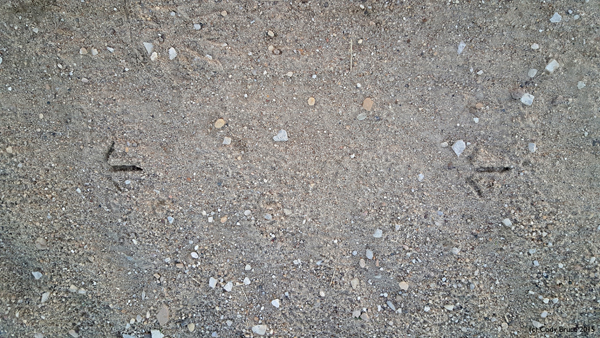
Not long ago a persistent drought seemed destined to rid our fair country of this spectacular bird. Yet, this parcel holds more promise than others. A wizened farmer with a heart for conservation had declared this acreage a sanctuary in years past. One can see that the choice has paid dividends. Cocks are taken regularly on surrounding properties but this piece of ground has remained undisturbed. As a result the field is practically rife with birds.
As we stroll back to the farmhouse I can’t help but think of Kansas as the realization of the conceptualization of America as the land of opportunity. Of course the folks here have proven that hard work and dedication can overcome great difficulty. Yet, there is also another level to it. With a simple love of our resources, Kansans have also ensured that they will be around for generations to come. Here in Russell County the ringnecks seemed to have weathered the drouth. Now reports indicate that the population of Lesser Prairie Chickens in Kansas’ Shortgrass Prairie has increased by approximately 27%. With a little luck the Northern Bobwhites across the state have faired similarly. Each bird is powerfully nostalgic in our state’s history and deserves our attentive dedication and concerned efforts. As we edge closer and closer to the welcome days of fall, let us all consider how we can not only stock the larder—but how we can all pitch in to conserve the birds that warm our memories and quicken our pulse.
2015 Fund Raiser at Ringneck Ranch
By Keith Houghton
Ringneck Ranch, Inc.
We’ve known it by more than one name: The Fun Hunt, Ugly Bird Shoot, and The Fun Raiser. This event is the life blood of our organization’s efforts to represent our industry.
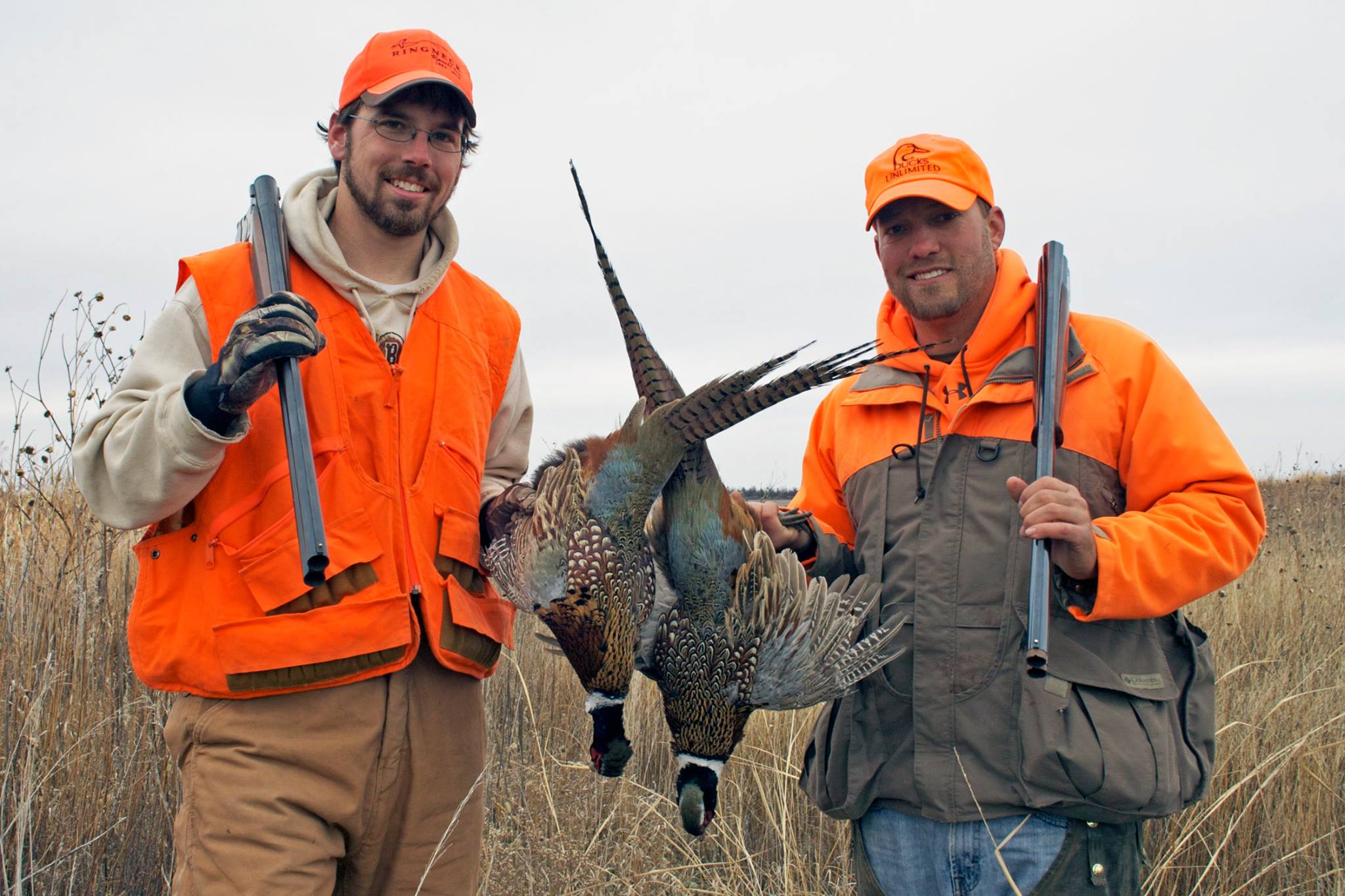
Ben Effenbach, KSU Wildlife and Outdoor Enterprise Management Intern and Kaj Larson, Ringneck Ranch Upland Gamebird Guide.
Those basic efforts are a hired professional that monitors legislation and regulations effecting our industry and a KSHA website that highlights our member producers, hunting service providers and supporting businesses.
We lean on our producers in helping to provide the gamebirds for this event with the prospective that our association nurtures businesses that continue to grow and make new and bigger gamebird customers.
We sincerely thank our producers that provided outstanding gamebirds for our KSHA Fund Raising Event.
- Prairieland Gamebirds, David and Ryan Wacker, Hunter, KS
- Rockers Pheasant Farm, Ron Rockers, Greeley, KS
- Kansas Game Birds, Ken Stringer, Whitewater, KS
- Beavers Game Farm, Beavers Family, Pierceville, KS
- Special T Hunting, Larry, Troy, and Trevis Tonne, Beloit, KS
- Pat Kruse, Simpson, KS
Cover for Hunting OR Hunting for Cover
Reprinted with Permission
NAGA News
May 2015
Most upland hunting operators are in an ongoing effort to create habitat that provides functionality, durability and aesthetics, which enhance the experience that bring their guests back. What they learn is that they are usually involved in ongoing annual experiments with an array of success and results. Many of the comments for this article are pointed toward opinions in hunting the pheasant species and may not always be correct for all species.
A one-size-fits-all approach is usually not applicable to the wide variety of operations with unique situations and needs. Some hunting areas can be successfully utilized with passive management of annual crop residue and perennial growth on waste ground that our appraisers now call “recreational properties”. This is cost effective, but may avail itself to some improvements with a little investment and management, particularly in areas that will be hunted intensely.
Implementation of conservation programs with some of the CRP continuous sign up can
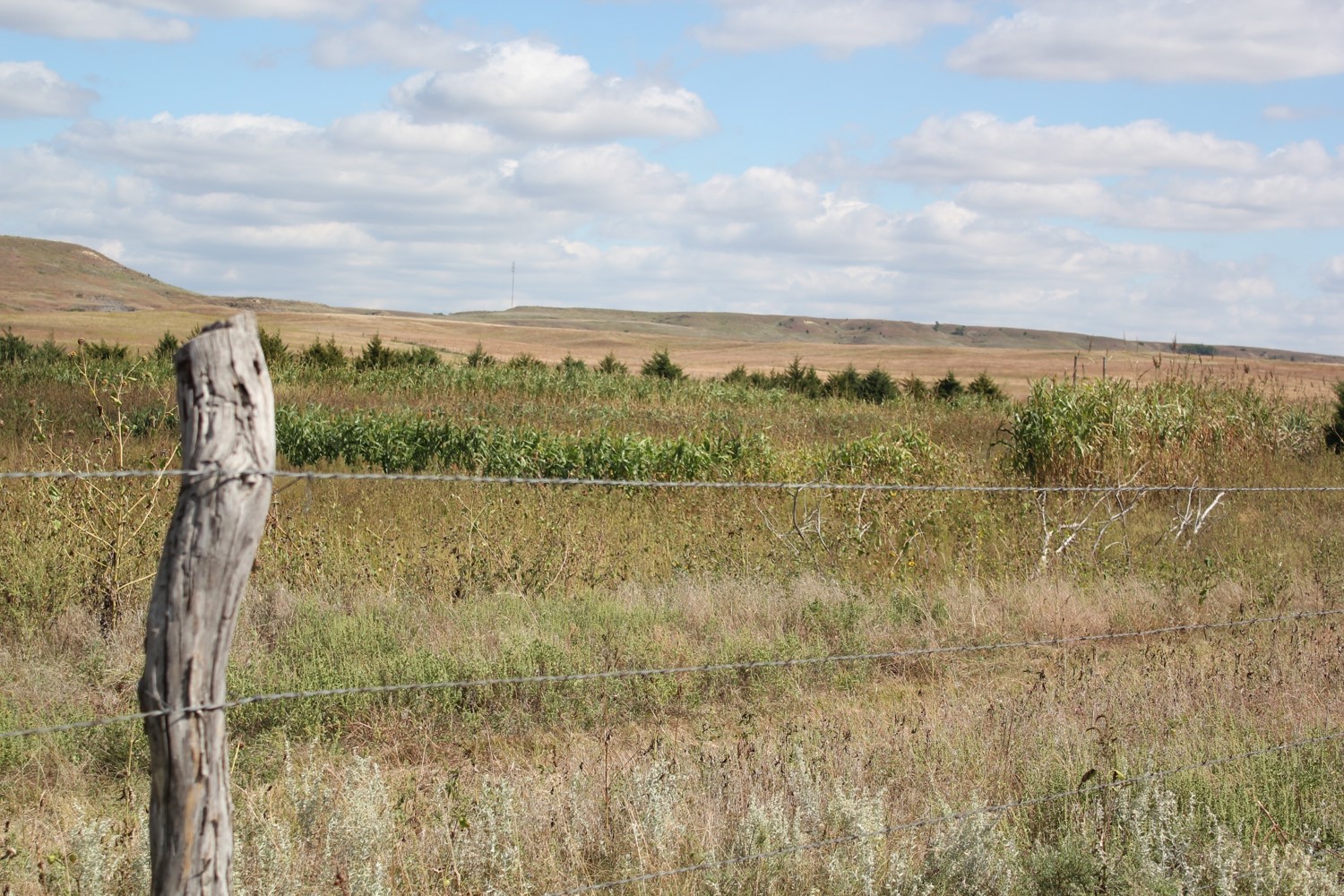
Combination of eastern red cedar shelter belt, native grasses, and sorghum mixes makes for a great pheasant hole.
be enticing for agricultural operations, especially when coupled with supplemental incentives when grain prices are at traditional levels. The filter strip CRP’s that are part of clean water legislation are very helpful in establishing hunt habitat from several perspectives. What may be an un-farmable draw through a field that is difficult to effectively hunt can become a drainage with bands of native grasses on each side that has all-season staying power.
The primary plant component for filter strips on the high plains is switch grass, it has a great appearance and resiliency that can still be with you at the end of the season. After establishment, annual burning, as an approved maintenance plan, will just improve it. Be advised that the particular makeup of the grass species mixes are determined by local FSA committee and they may have some latitude for variance. There are a variety of switch grass species with different characteristics. A moderate height is desired as some varieties can become 6 ft. tall and impede a safe hunting and shooting environment. The switch grasses’ greatest attribute is its ability to recover from a blizzard or ice storm that takes it to the ground, but stands back up with the snows dissipation. The filter strips provide a situation to facilitate small hunting parties in an efficient recovery of your gamebird assets. The establishment of the filter strip allows a straightening of field borders that assists with Ag operation efficiency. Strips are generally 30-120 ft. wide borders. You don’t need 120 feet of removed production to do the job, but 30 feet can be a bit tight for some hunting groups.
In establishment of cover/food plots, they should be located so parties can hunt them sequentially and systematically for a couple hours. A smooth flow will allow you to accommodate successive parties with relative ease; and with good coordination you can routinely hunt some areas with different parties four times a day.
The addition of annual sorghums, a traditional feed source and cover for upland gamebirds, can add the aesthetic elements that are ideal in accommodating a gamebird liberation environment. A variety of ideas on this have evolved at different operations. Generally a cover with adequate canopy will allow you high success in placement & distribution in daylight situations.
A major point that we think is important is the “you need more cover than you think you want to start, in order to have enough at the end.” Early season hunts of some sorghums can be challenging to the asset recovery teams. Resist the temptation to be overly aggressive with the bush hog when staff or guests comment that it is too thick, as they will be the same folks complaining of skimpy cover in January & February. The use of a smaller bush hog/mower can actually be of significant help in that it designates walking paths that help keep hunters from destroying established habitat and ground cover. Any self-respecting pheasant hunter thinks he has an obligation to kick every weed he comes close to. The defined path helps with this problem and guests will soon realize that the dogs don’t need all that much help.
Sorghum, milo, cane, and silage are first cousins widely utilized in establishing complementing cover/feed plots in much of North America. The sorghums are favored by the hunter and the hunted and can be managed to facilitate your respective operation.
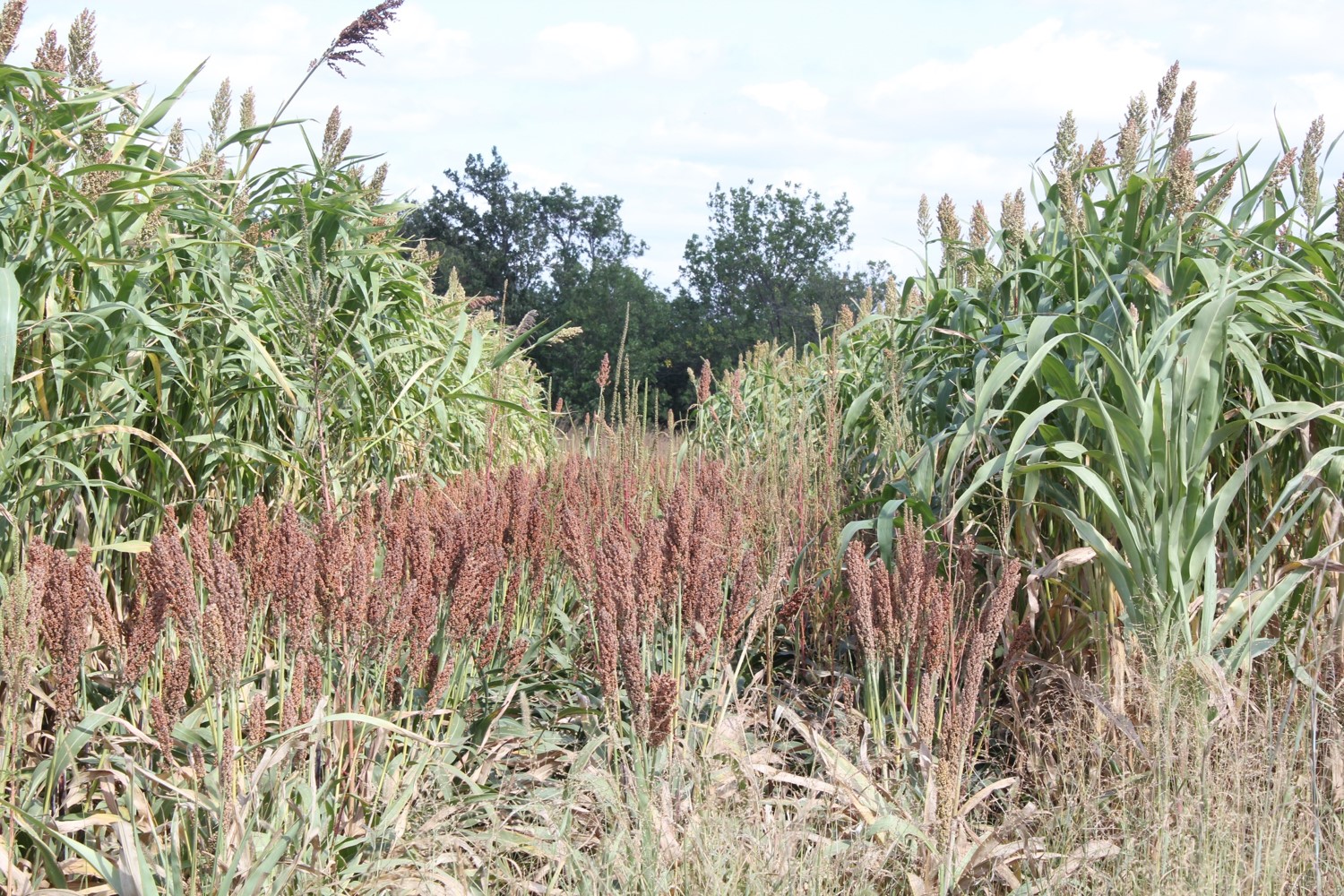
Interior planter boxes of milo with outside two rows of hybrid sorghum for feed and cover.
We utilize an old first generation 8-row no-till planter with four interior rows of mixed milo varieties. Check with your local seed distributor for leftover test plot sorghum seed. Mixing the different varieties and colors yields great eye appeal. We plant the outside two seed boxes with a taller sorghum that at maturity or freeze down will hopefully break over at mid-stalk and lodge to make great sanctuary for hiding roosters. Try to avoid varieties with a heavy grain head that may be prone to breaking at ground level with a heavy wet snow or wind. It is beneficial to identify varieties with good leaf retention and adequate stalk strength for ice and snow issues that the typical seed company salesmen have not been coached about. The Pheasants Forever mixes (Blizzard Buster is one) have been developed for these objectives and can be a usable ready-made mix. Most of the sorghums won’t do well without fertilization, especially nitrogen.
The ongoing challenges that we face are the places where we prefer to annually plant the sorghums. In doing this, we foster some objectionable plant species. Our two biggest problems are with shatter-cane (a sorghum renegade first cousin) and pigweed (sometimes called red root) that the birds, dogs and people find to have no redeeming qualities. You can try to fight problem species with a combination of tillage, crop rotation, and pre- and post- emergent. The last four years have shown us that none of these techniques work without precipitation. The ideal answer would be a round-up ready sorghum seed variety, but the geneticists tells us that they are afraid of creating an evolved monster that might be more than difficult to control.
The only annual that comes close for rotational purposes is a Roundup Ready corn, but we don’t feel that standing corn offers adequate cover characteristics.
There is a substantial resource available in the Pheasants Forever staff that work in the FSA/NRCS offices. They are knowledgeable & can assist operators in implementing the wildlife CRP programs.
RR/NAGA/NAGA article May 2015